
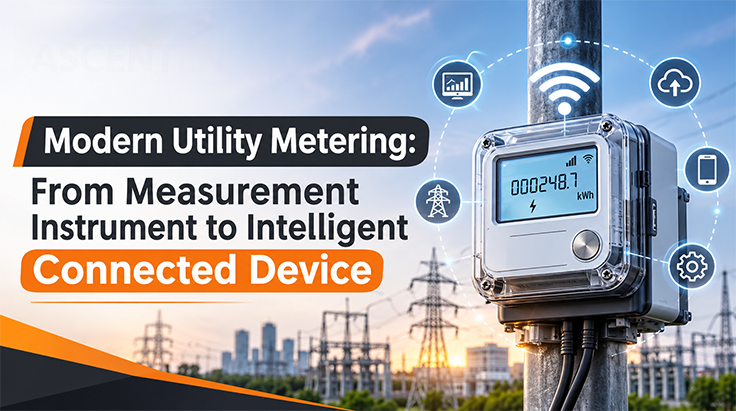
Utility meters have always had one fundamental job: measure consumption accurately. What has changed is everything around that measurement.
The traditional electromechanical meter was developed to measure energy locally. In today’s context, a utility meter measures, processes, stores, communicates, and responds to information coming from an external source. This has transformed the meter from being an individual measurement device to an integral part of the utility digital system.
Traditional electricity meters utilised electromechanical technology, comprising spinning disks and mechanical counters. They operated quite independently from any computer software and communications.
Static or electronic meters, which came later, brought about the use of electronics for sensing and measurement purposes. This enhanced the performance of electricity meters while allowing the implementation of additional features like event recording, different rates and communications.
The next step was connectivity.
Traditional meters require manual reading. AMR (Automatic Meter Reading) introduced remote collection of meter data, reducing the need for physical visits. Smart meters take this further by supporting two-way communication, remote operations, event reporting and integration with utility systems.
This distinction is important because connectivity changes the role of the meter. It becomes part of an operational network rather than simply a device installed at a consumer location.
A modern meter combines several engineering disciplines. At the measurement level, sensors and metrology algorithms determine consumption. At the electronics level, processors, memory, power management and interfaces handle the measured information.
Embedded firmware controls how the device operates, manages measurement algorithms, records events and communicates with external systems. Communication technologies then connect the meter to the utility's infrastructure.
Ascenten works across these areas, including hardware engineering, embedded software, IoT engineering, algorithm development and metering systems. Its metering expertise covers energy, gas and water applications with communication protocol and AMI ecosystem compatibility.
Connectivity cannot compensate for inaccurate measurement. A utility meter must first satisfy its metrological requirements.
Accuracy depends on the sensing architecture, analogue front end, component characteristics, calibration, algorithms and environmental conditions. Legal metrology adds another layer of requirements because measurements may have commercial and regulatory significance.
Modern regulations increasingly address software as part of the legally relevant measurement system. Requirements can include software identification, protection against unauthorised modification and controlled software updates.
Electronics architecture will usually comprise sensing of voltages and currents, analogue processing, metering ICs or MCUs, memories, power supplies, display interfaces and communication interface modules.
The power supply design also has to support the different operating conditions of the meter. Depending on the application, the electronics may need to continue performing critical measurement and data functions during supply disturbances or changes in operating conditions. Component selection, thermal considerations and power consumption therefore become part of the overall meter design.
Firmware will link all these pieces of hardware to form a functional product. It can perform calculations of measurements, timing, tariff management, data storage, diagnostics, event handling and communication.
For connected meters, firmware also has to manage reliability over a long deployment lifecycle. Ascenten’s embedded engineering experience includes ARM, PIC, MSP430 and Kinetis platforms, along with protocols such as TCP/IP, Modbus, CAN and DLMS.
The firmware architecture also needs clear separation between measurement functions, application logic, communication handling and security-related functions. This makes the product easier to test, maintain and update as requirements change during its deployment lifecycle.
The quality of a digital meter depends on more than the sensing hardware. Measured signals have to be sampled and processed correctly before the meter can calculate useful consumption information.
Metering algorithms can handle parameters such as voltage, current, active energy, reactive energy, power factor and other electrical characteristics, depending on the meter type. Filtering, calibration and compensation can also be required to account for characteristics of the sensing and analogue circuits.
The processed information may then be stored as cumulative readings, interval data, events or other records required by the application. This creates a link between metrology, firmware and the data model used by the wider utility system.
The communication layer makes it possible for meters to communicate with remote systems via suitable wired or wireless communications. The architecture might utilise local interfaces, RF, cellular, PLC, and other communication means depending on the application requirements.
Connectivity introduces new challenges in terms of security, which can be addressed through the use of authentication, secure communication channels, secure firmware, and access control. Tamper detection can further address issues such as enclosure opening, magnetic interference, and abnormal wiring.
Security also needs to be considered throughout the meter lifecycle. Device identity, key management, authenticated communication, controlled access and protection of stored information are relevant when a large number of meters are connected to a common utility infrastructure.
This kind of architecture allows utilities to gather information remotely and use it for billing, monitoring, managing outages, analyzing demand, and planning operations. CEA has also developed specifications and guidelines on the communication aspects of AMI that include communication between smart meters, HES, and MDM.
The interface between these layers is significant since the meter is only one component in the whole process of gathering information. The information gathered by the meter should reliably pass through the communication layer, HES, before it reaches the utility application.
The interface between these layers is important because the meter is only one part of the complete information flow. Meter data has to move reliably from the device through the communication network and HES before it can be processed by utility applications.
Smart meters allow for remote configuration, as well as firmware upgrades under permitted conditions based on the regulatory environment in which the devices operate. This can lower the cost of fieldwork for the utility operator.
But remote upgrades have to be highly secure. Upgrades of legally important software require controlled processes of updates and integrity assurance.
Remote configuration can also be used for selected operational parameters, tariff settings and communication-related functions where permitted. Such functions require appropriate access controls so that configuration changes can be authorised and traced.
Data collected from the meter and transmitted to utility systems can be analysed for consumption trends, unusual events, losses, and network behaviour. Utility applications will make information out of this raw data.
A communicating meter needs to be able to effectively exchange data with both equipment and software in the metering environment. As such, interoperability plays a critical role in product development.
DLMS/COSEM protocols allow structured data exchange between meters, but there are also other protocols that may be utilized according to applications.
Interoperability also affects testing. A meter may need to be validated against its communication interface, protocol implementation, HES integration and the expected data exchange with downstream systems. Addressing these requirements during development can reduce integration issues during deployment.
Testing a connected meter extends beyond checking its measurement accuracy. Hardware, firmware, communication and security functions all need to be validated as part of the product.
Measurement testing can verify accuracy across specified operating conditions. Firmware testing can cover calculations, event handling, data storage, tariff functions and fault conditions. Communication testing can verify protocol behaviour and reliable data exchange with external systems.
Long-term reliability also needs consideration because utility meters are deployed in the field for extended periods. Environmental conditions, power variations, communication failures and abnormal operating conditions can all affect product behaviour and therefore need to be considered during validation.
The future of metering will involve deeper integration between measurement electronics, embedded intelligence, secure communications and utility software. India's smart-metering programme already demonstrates the scale of this transition, with 5.28 crore smart meters reported installed across the country under various schemes as of December 31, 2025.
For product developers, this means metering design increasingly requires expertise across the complete device lifecycle, from sensing and electronics to firmware, communication, cybersecurity and system integration.
Looking to develop or modernise a connected metering product?
Connect with Ascenten to discuss your electronics, embedded systems, IoT and metering engineering requirements.
Connect with AscentenContact Us
We would really like to hear from you and answer any questions. Please email us at info1@ascenten.net
or call us on
India Landline: +91-79-2646 4646
India Mobile: +91-89800 00973