
How Product Engineering Services Turn Ideas into Market-Ready Products
Home > Tech Notes > Product Engineering Services
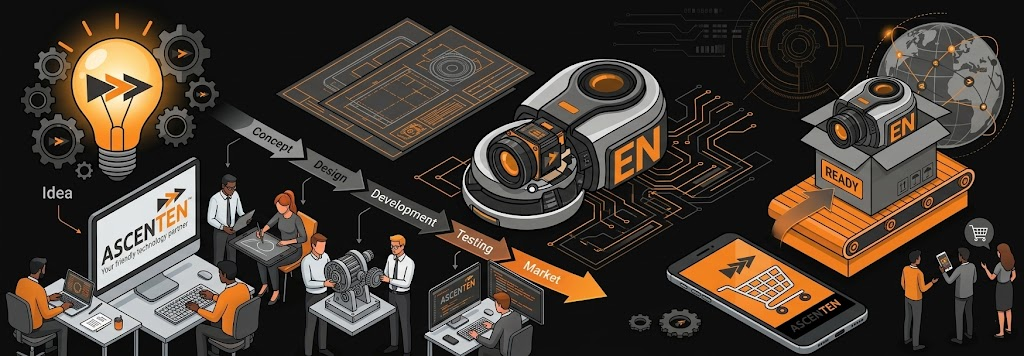
Having a good product idea is just the beginning for organizations of the modern type. Making that idea a reliable, scalable, manufacturable and commercially viable product is the hard part.
This is where Product Engineering Services play an important role. Product engineering involves several engineering disciplines all working toward the common goal of creating a product that will function in the real world; from product definition and architecture all the way to prototyping, software development, testing and optimization, and production support.
The key to the success of any product engineering solution is to strategically address the risks associated with the development process, time-to-market, and to build a safer and more solid basis for future product variations especially for startups and OEMs.
Product Engineering – What is it?
Product engineering is an integrated process of designing, developing, verifying and optimizing products in their life cycle. These are mechanical engineering, electronics, embedded systems, firmware, software, cloud platforms, IoT, automation, and industrial design for various products.
Typically starts with the understanding of the product requirements and development of a viable engineering structure. The engineering teams then move on to design, prototype, develop, test, validate and manufacture.
Product engineering is about considering the wider picture, as opposed to the traditional approach which will only consider building the specified requirements:
What problem does the product solve?
- What problem does the product solve?
- How will users interact with it?
- What technical architecture can support future requirements?
- How will the product perform under real operating conditions?
- What reliability, security, safety, or regulatory requirements apply?
- How easily can the design move from prototype to production?
That combination of engineering expertise, product thinking, and lifecycle planning is what turns an idea into a product that can survive beyond the prototype stage.
How Product Engineering Turns Concepts into Real Products
Start with Product Requirements and Engineering Strategy
A strong product does not begin with coding or hardware design. It begins with clearly defined requirements.
Product engineering teams work with stakeholders to understand business objectives, user expectations, technical constraints, target environments, and performance requirements. These inputs are converted into engineering specifications and a development roadmap.
For instance, in the case of an industrial internet of things product, the engineering team has to ensure that the product operates efficiently in a challenging environment, while at the same time providing various forms of communications capabilities.
Making these decisions early prevents expensive redesigns later in the development cycle.
Build the Right Hardware and Software Architecture
Product performance is strongly influenced by architectural decisions made at the beginning of development.
Depending on the product, this may involve:
- Microcontroller or processor selection
- Sensor and communication interface selection
- PCB architecture
- Embedded firmware
- RTOS or software architecture
- Cloud connectivity
- API and application development
- Data management
- Security architecture
- Power management
For embedded products, for instance, selecting a processor is not simply a matter of processing speed. Memory availability, peripheral support, power consumption, operating temperature, long-term component availability, and firmware requirements can all influence the decision.
A well-planned architecture gives engineering teams room to improve the product without redesigning its core foundation every time a new requirement appears.
Validate Ideas through Rapid Prototyping
A concept may look technically sound on paper but behave very differently when converted into a working prototype.
This is why rapid prototyping and product development are critical stages of product engineering.
Engineering teams can use prototypes to validate:
- Hardware functionality
- User interaction
- Communication performance
- Mechanical integration
- Firmware behaviour
- Power consumption
- Sensor accuracy
- System-level performance
Consider a connected industrial device that communicates through Wi-Fi, Ethernet, or cellular connectivity. A prototype can reveal practical issues such as communication instability, thermal constraints, unexpected power consumption, or firmware limitations before the product reaches expensive validation stages.
The objective is not simply to build a prototype. It is to use the prototype to make better engineering decisions.
Integrate Advanced Technologies across Engineering Disciplines
Modern products rarely depend on one engineering discipline.
A connected product may require electronics, embedded firmware, cloud infrastructure, mobile applications, cybersecurity, data analytics, and mechanical design to work together.
This is where experienced Product Engineering Service Providers can add significant value.
For example, an IoT-enabled industrial product may involve:
Sensors → Embedded Controller → Firmware → Communication Layer → Cloud Platform → Application → Analytics
Each layer has its own engineering requirements, but the final product must function as one integrated system.
Engineering teams therefore need to consider interfaces, data flow, communication protocols, failure conditions, security, and system-level performance rather than optimizing individual components in isolation.
Engineer for Reliability, Security, and Real-World Conditions
A product that works successfully in a controlled development environment is not necessarily production-ready.
Engineering validation needs to consider the conditions under which the product will actually operate.
Depending on the product category, this may include:
- Functional testing
- Performance testing
- Environmental testing
- Thermal testing
- EMI/EMC testing
- Reliability testing
- Software and firmware validation
- Security testing
- Stress and endurance testing
- Hardware-software integration testing
For connected and embedded products, security should also be considered during architecture and development rather than added immediately before launch. Secure boot, firmware integrity, authentication, encrypted communication, secure update mechanisms, and protected credentials may all become important depending on the product's risk profile.
This early engineering focus helps identify issues before they become expensive field failures.
Optimize the Product for Manufacturing and Scale
One of the common gaps between a successful prototype and a successful commercial product is design-for-manufacturing and production readiness.
A prototype may work perfectly while still being difficult or expensive to manufacture at scale.
Product engineering teams therefore evaluate factors such as:
- Component availability
- BOM optimization
- PCB manufacturability
- Assembly requirements
- Testing procedures
- Component lifecycle
- Production tolerances
- Supply-chain constraints
- Cost targets
This stage connects R&D with manufacturing and helps ensure that engineering decisions remain commercially practical.
Working with an experienced product engineering partner can provide access to specialized engineering capabilities without requiring an organization to build every competency internally.
Faster Time-to-Market
A structured engineering process can reduce development bottlenecks and accelerate movement from concept to prototype and from prototype to production.
Access to Specialized Expertise
Businesses can access multidisciplinary expertise across embedded systems, electronics, software, IoT, cloud, automation, testing, and product development.
Reduced Development Risk
Early prototyping, architecture validation, and structured testing help identify technical problems before they become expensive production issues.
Better Product Scalability
A lifecycle-oriented engineering approach creates architectures that can accommodate future product versions, additional features, and changing market requirements.
Improved R&D Efficiency
Outsourcing selected product engineering activities allows internal teams to focus on product strategy and core business priorities while specialized engineers manage complex development requirements.
Transform Your Product Idea into an Engineering Solution
If you have a good idea, you need more than that to make a successful product. To turn this idea into a reliable product ready for the market, it needs the right architecture, engineering choices, validation approach, and development skills.
Utilizing their engineering and engineering-to-product development expertise and capabilities, Ascenten Technologies provides organizations with Product Engineering Services to facilitate product innovation. Our expertise covers product architecture and prototyping, embedded software development, software integration, testing, and production readiness all of which help businesses reach commercialization with greater confidence.
For a new product concept or to update a current product, talk to Ascenten Technologies about your engineering needs and development timeline.
Talk to Our ExpertsContact Us
We would really like to hear from you and answer any questions. Please email us at
info1@ascenten.net
or call us on
India Landline: +91-79-2646 4646
India Mobile: +91-89800 00973