
Cyber Resilience Act 2027 Why Most Product Companies Are Underestimating the Engineering Effort
Home > Tech Notes > Cyber Resilience Act 2027
The Cyber Resilience Act (CRA) can be considered as one of the most important cybersecurity legislations that has been enacted by the European Union in regard to manufacturers of digital and connected products. Although many companies treat CRA as just another compliance mandate, the truth of the matter is very different.
For the Original Equipment Manufacturers (OEMs), for embedded product manufacturers, and for engineering-centric organizations, the process of becoming compliant with the Cyber Resilience Act is much more complex than that of merely fulfilling the document requirements.
Unlike traditional regulatory frameworks, the Cyber Resilience Act emphasizes security throughout the complete lifecycle of a product. Rather than considering cybersecurity as a test prior to release, the company needs to include security at each phase of engineering from architecture and software development to deployment, maintenance, and disposal.
In order to get compliance, the manufacturer will need process controls for:
Under CRA, engineering responsibility continues well beyond product launch. Maintaining security becomes an ongoing commitment rather than a one-time certification exercise.
One of the biggest misconceptions surrounding the Cyber Resilience Act is that cybersecurity teams alone can handle compliance. In reality, successful implementation requires collaboration across multiple business functions.
Engineering Teams
Responsible for secure architecture, secure coding practices, design validation, and security testing throughout development.
Firmware Teams
Must implement secure boot, authentication mechanisms, encryption, secure communication protocols, and trusted firmware update capabilities.
DevSecOps Teams
Integrate automated security testing into CI/CD pipelines, manage software dependencies, generate SBOMs, and continuously monitor vulnerabilities.
Product Management Teams
Define cybersecurity requirements, plan long-term product support, and ensure regulatory obligations align with business goals.
Without close coordination between these teams, achieving sustainable CRA compliance becomes extremely challenging.
Many organizations focus heavily on compliance documentation while underestimating the engineering effort required behind the scenes.
Key engineering activities include:
Threat Modelling
Identifying potential attack scenarios during product design rather than after deployment.
Secure Architecture Reviews
Evaluating and redesigning product architectures to eliminate security weaknesses.
Vulnerability Management
Establishing structured processes to identify, prioritize, remediate, and document vulnerabilities throughout the product lifecycle.
Software Bill of Materials (SBOM)
Maintaining an accurate inventory of software components to respond quickly to newly discovered vulnerabilities.
Secure Update Mechanisms
Ensuring products support authenticated and reliable firmware or software updates throughout their supported lifecycle.
These activities often require significant engineering resources, especially for organizations managing legacy products.
Several misunderstandings continue to delay CRA preparation.
CE Marking Does Not Automatically Mean CRA Compliance
Although the CRA forms part of the broader CE marking framework for applicable products, existing CE certification alone does not demonstrate compliance with cybersecurity obligations.
Penetration Testing Alone Is Not Enough
parsePenetration testing remains an important validation activity, but it is only one element of compliance. Organizations must also demonstrate secure development practices, lifecycle security, vulnerability management, secure update mechanisms, and documented engineering processes.
Waiting until the final stages of implementation often increases both engineering effort and overall project costs.
Organizations that delay preparation commonly face:
Starting early enables organizations to distribute engineering work across multiple product releases rather than attempting expensive last-minute changes.
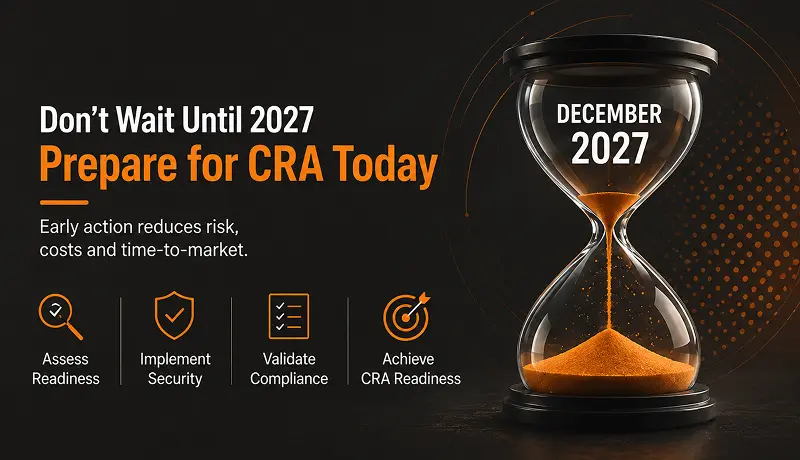
Engineering readiness cannot be achieved within a few months. A phased approach is essential.
Assess Current Readiness
Conduct engineering assessments, review product architecture, identify cybersecurity gaps, evaluate development processes, and establish a CRA compliance strategy.
Implement Security Improvements
Adopt Secure Software Development Lifecycle (SSDLC), strengthen DevSecOps practices, implement SBOM generation, improve firmware security, and redesign products where necessary.
Complete Validation
Prepare all documentation for compliance, develop lifecycle management procedures, confirm the security of the update process, finish the management of vulnerabilities, and check compliance in general by December 2027.
Organizations that begin early will experience significantly less disruption than those delaying implementation.
How Ascenten Technologies Helps
CRA compliance is impossible without a robust engineering framework. Ascenten Technologies assists OEMs and product companies in evaluating their engineering preparedness, implementing strong SDLC principles, practicing DevSecOps, handling SBOMs, and ensuring the security of the product throughout its life cycle.
We provide you with a realistic implementation plan that allows you to be CRA compliant in time before December 2027. Contact Ascenten Technologies for a seamless path to compliance and secure products.
Contact Us
We would really like to hear from you and answer any questions. Please email us at info1@ascenten.net
or call us on
India Landline: +91-79-2646 4646
India Mobile: +91-89800 00973