
Home > The Life Saver – An In-vehicle Accident Safety Device
Admin | Posted on 19/07/12
On a slow, hot April afternoon I was heading to my Koba office. My car had juggled for a good 30 minutes through a maze of bumpy, crowded Ahmedabad roads and as I approached Avani circle I had felt a sense of relief – the rest of the road would be an uncluttered highway which meant smooth sailing and I could focus on my work in my driver driven vehicle. As we cruised along the highway, a myriad of thoughts occupied my mind – on consolidating marketing and sales at Ascenten, on test results of our recent metering project and on my impending trip abroad. In a few minutes I felt the car slowing down and looked outside the window. I could see some people walking around on the road and as we kept moving the crowd kept growing bigger to the point that the car almost came to a stop. “What’s going on?”, I softly asked the driver. “Seems like an accident”, came a casual reply. “Well do you see something?”, I asked. “Yes, there is a #### #### on the right side”, he murmured. “What?”, I gasped in disbelief as I jumped across to the right seat, glancing out. As I watched, a sinking feeling came to me. My heart sulked in. Suddenly I felt a tremendous sense of emptiness. What I saw that day is something I will perhaps never forget. It was not graphic, rather something quite innocent.
Road death statistics globally and especially in India are certainly very overwhelming. The WHO Global Status Report on Road Safety, 2009 claims that 1.2 million die on roads every year and as many as 50 million are injured. These numbers translate to more than 12 million deaths in a decade and on a vague statistical assumption of 10 life-changing injuries happening per every death, it evaluates to a ball-park 120 million life-changing injuries in a decade. These numbers are far more than any terror or war can afflict. And assuming that for each life-changing injury, lives of two additional family members being affected, the per-decade statistic for the number of lives affected comes to 360 million. This means that in a generation time of typically 7 decades, 84 million people will die on roads and 2.5 billion people’s lives will change forever due to road accidents; that is if things don’t change.
However road accidents are like an invisible evil that plagues our world with grave complacency and lack of common sense amongst the masses, as is evident from historical public protests in parts of India against new safety rules such as mandating helmets on two wheelers. Even amongst the elite educated masses we often see a disregard for seat belts and speed.
The problem needs to be tackled immediately and in this letter I propose an achievable, practical in-vehicle technology solution that holds good promise to be part of a larger solution that should also include innovative on-road technologies, better road planning, safety education in schools, awareness campaigns, new vehicle safety regulations and new government policies. However changing people and roads take a long time, probably a generation and that is where an in-vehicle technology should kick in for quicker results.
The Life Saver
A new vehicle safety regulation must be introduced requiring every new vehicle manufactured to contain a hard, rugged, sealed electronic device called Life Saver whose function is to enhance safety on roads while doubling as the vehicle Engine Control Unit. The Life Saver is tamper resistant, vandal resistant and connects to a number of different types of secure, certificate-exchanging sensors spread around in the vehicle. The Life Saver has a number of technologies working in coherence to enhance safety. Any deliberate attempt to tamper with the Life Saver or its sensors should render the vehicle defunct in few days and enable intermittent wireless broadcast of the tamper event to notify traffic cops, who in turn are well equipped to identify the tampered vehicle. The Life Saver performs the following safety functions:
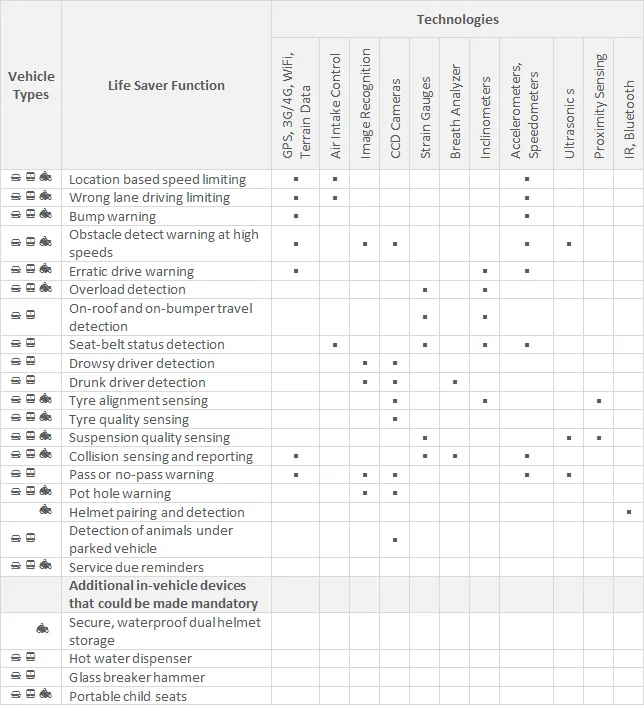
The operation of the Life Saver is described above in a very simplistic manner so that the concept is clearly understood. The actual operation, however, will be quite intricate since it would involve warning the user multiple times and maintaining a time period for corrective action before limiting the speed or disabling the vehicle.
Apart from the Life Saver, the following gadgets if made mandatory can prove to be strategic in saving lives:
The Life Saver could typically add Rs. 20000 (USD 400) to a vehicle cost when mass produced – a paltry sum to pay per vehicle for 360 million lives in the next 10 years. The engineering complexity is not overwhelming; it is as much as what one can find in a typical smart phone or a high end PC these days. Although a few technologies described above already exist, they’re not available as a unified, single, mass produced, government mandated, net-connected, vandal-proof and tamper-evident hard metal box. That is what the Life Saver is.
We would really like to hear from you and answer any questions. Please email us at info1@ascenten.net
or call us on
India Landline: +91-79-2646 4646
India Mobile: +91-89800 00973
Home | Careers | Ethics | Privacy Policy | Terms Of Use | Code Of Conduct