
Innovating Energy Solutions with Smart Meter Design Services
Home > Tech Notes > Smart Meter Design Services
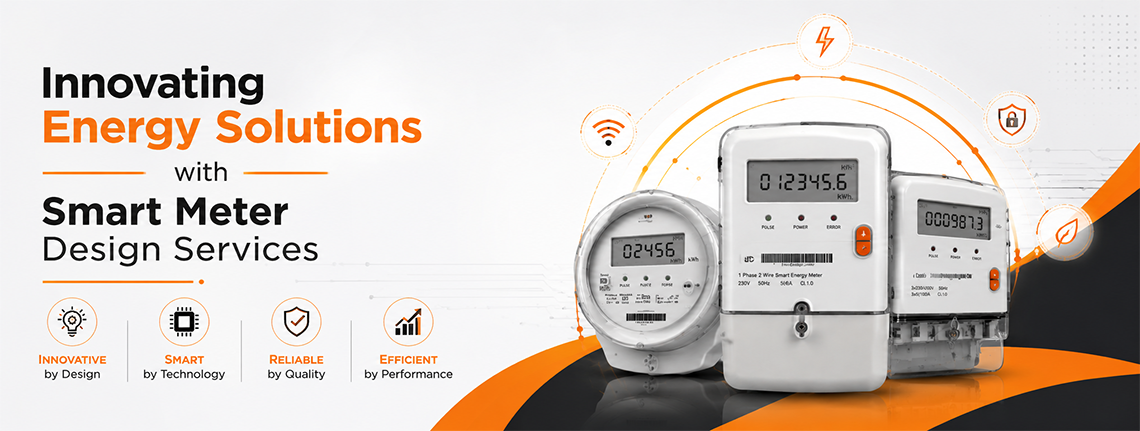
The energy sector is experiencing fast evolution through the adoption of smart grids, renewable energy, and the digitalization of utilities. As a result of the need to be efficient, reliable, and sustainable, the smart meter has become an important component of the contemporary energy management system. The main difference between the traditional electricity meter and the smart meter is that the latter allows the utility company to manage the energy flow more efficiently.
Nevertheless, creating an operational smart meter is much more difficult than just integrating electronics into the device. It requires skills in designing the hardware itself, creating the embedded firmware, communication protocols, cybersecurity, compliance, and validation of the system. That is where professional Smart Meter Design Services can be extremely useful for the OEMs and utility companies.
Smart meter engineering demands a multidisciplinary approach that balances performance, accuracy, security, and long-term reliability.
An important problem here is obtaining accurate energy measurements despite fluctuating voltage, current, and environmental parameters. The choice of suitable metering ICs and sensors, as well as the way of their calibration, is crucial in order to achieve utility-level accuracy.
Another problem is developing electronic devices capable of working in extreme outdoor conditions. It is necessary to solve such problems as heat dissipation, lightning protection, PCB layout, EMC compliance, and others.
Power efficiency is equally important. Modern smart meters integrate microcontrollers, communication modules, displays, and security features while maintaining low power consumption. Optimizing hardware architecture and embedded firmware is critical for delivering consistent performance without compromising energy efficiency.
A robust hardware platform forms the foundation of every intelligent metering solution. It typically includes high-performance microcontrollers, precision energy metering ICs, analog front-end circuitry, communication modules, memory devices, power management systems, tamper detection sensors, and protection circuits.
Apart from the selection of the components, the successful product development is also dependent upon PCB design, signal integrity, electrical isolation, and thermal management. Taking into consideration these engineering aspects during the early stages of the development process leads to reduced effort spent on redesigns, improved product quality, and shorter time-to-market.
The embedded firmware plays the role of the brain in the hardware. It deals with energy measurements, communication, data logging, diagnostics, display management, tamper-proofing, and firmware updates.
Effective communication is very important for smart metering today. The communication between smart meters and Head-End Systems (HES) and Meter Data Management Systems (MDMS) should be safe and reliable. The communication protocol DLMS/COSEM became the international standard for smart meter communication since it allows the secure and reliable exchange of data in utility networks. Moreover, engineers consider different connectivity solutions including RF Mesh, NB-IoT, LTE Cat-M, Power Line Communication (PLC), Ethernet, and cellular networks.
Selecting the right communication architecture ensures reliable operation across diverse utility environments while supporting future smart grid expansion.
As connected devices become integral to critical infrastructure, cybersecurity is no longer optional. Smart meters process sensitive operational and consumer data, making secure product design a key engineering priority.
A secure smart meter will have components like secure boot, encryption, authenticated firmware updates, and secure keys storage, authentication of devices, tampering detection, and role-based access control. The inclusion of all these components during the entire life cycle of product development reduces any possible risk of failure.
Compliance is equally important for successful deployment. Designing products in accordance with standards such as IEC 62052, IEC 62053, IS 16444, IS 15959, and DLMS/COSEM helps ensure measurement accuracy, interoperability, and regulatory acceptance while reducing certification risks.
Prior to being used commercially, smart meters should be thoroughly tested for function, calibration, communications, environmental resistance, and electromagnetic compatibility.
This entails such processes as functional testing, calibration, thermal/humidity testing, surge protection testing, vibration testing, and EMC testing. This allows engineers to detect any problems prior to deployment of the device in the field.
Developing next-generation smart meters requires expertise across electronics engineering, embedded software, communication technologies, compliance, and manufacturing support. Managing these disciplines internally can significantly increase development complexity and timelines.
Ascenten Technologies provides comprehensive Smart Meter Design Services, assisting OEMs in all aspects of the product development life cycle from conceptualization, architecture design, embedded firmware design, communication protocol integration, prototyping, testing, validation, and production engineering.
Our engineering-first mind set enables us to help our customers innovate quickly, mitigate technical risks, and provide dependable smart metering solutions.
The future of energy management lies in intelligent, secure, and connected metering technologies. As the utility companies evolve their infrastructures, the need for efficient smart meters only increases. To excel in the emerging market, it is not enough to have cutting-edge hardware; it also takes an experienced team of engineers in areas ranging from product design to cybersecurity.
Thanks to its broad range of product engineering services, Ascenten Technologies allows organizations to build scalable and forward-looking smart metering systems.
Contact Us
We would really like to hear from you and answer any questions. Please email us at info1@ascenten.net
or call us on
India Landline: +91-79-2646 4646
India Mobile: +91-89800 00973