
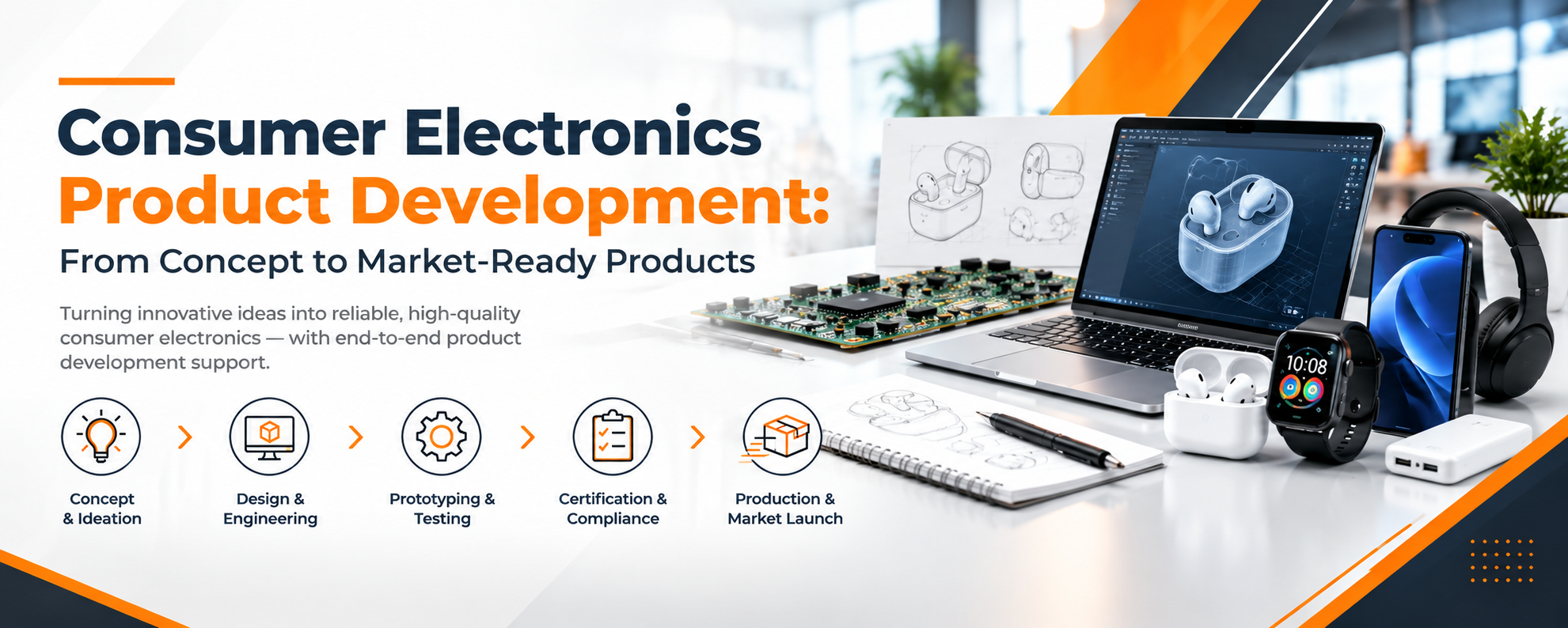
A consumer electronics device never comes out from a production line, but always originates from just an idea. This could be something that people wish to have or make things easier or something that has the potential to offer a better user experience with a new technology.
What is really challenging is to convert that idea into a product that is usable and feasible for manufacturing at reasonable costs.
The process of developing consumer electronics products is much more than just creating a circuit board. It includes hardware, firmware, PCB design, mechanical design, wireless, testing, and manufacturing. On the other hand, it has to fulfil very realistic criteria; it should be small, user-friendly, reliable, cheap, comfortable, and have sufficient battery life.
That balance is what makes consumer electronics development different from simply building a working prototype.
Every development journey should begin with the user.
What will the product do? Who will use it? Where will it be used? How small does it need to be? How long should the battery last? What should it cost? Does it need Bluetooth or Wi-Fi? What happens if it is dropped? How many units may eventually need to be manufactured?
These questions help define the product before engineering decisions are made.
They also reveal trade-offs early. Adding another feature may improve functionality, but it can increase the BOM cost, PCB area, software complexity, or power consumption. A larger battery may provide longer runtime, but it also adds size and weight.
A well-experienced R&D team never just checks if something is possible to build. Instead, they check if something is possible to build within the necessary parameters of cost, size, power, performance, reliability, and manufacturability.
A structured feasibility study helps establish a realistic product architecture before significant development effort is invested.
Once the product requirements are clear, hardware engineering begins.
A consumer device may consist of a processor or microcontroller, sensors, memory, displays, communications circuitry, power management circuitry, charging circuitry, interfaces, and protective circuitry.
Selecting these components is rarely as straightforward as selecting the highest specification.
For instance, a high processing speed may boost performance, but it will use more power and produce more heat. In addition, using a less expensive part will lower BOM costs, but this is only possible if its availability is not in question.
Engineers typically have to balance:
- Performance against power consumption
- Battery capacity against size and weight
- Features against BOM cost
- Component cost against lifecycle availability
- Processing capability against thermal output
- Miniaturisation against manufacturability
These decisions have a direct effect on the final product.
PCB Design: Small Size, Big Engineering Challenges
For consumer electronics, PCB design is often a space-management exercise as much as an electrical one.
The board may need to fit inside a very compact enclosure alongside the battery, antenna, connectors, sensors, display, charging circuitry, and mechanical supports.
Higher PCB density can assist in reducing the overall size of the product, though on the flip side it becomes challenging when it comes to managing heat dissipation and RF capabilities. All the sensitive analogue circuits, high speed digital circuits, power portions and RF portions have to be taken into account.
This creates real-world engineering trade-offs:
- PCB density vs. thermal performance
- Board size vs. RF performance
- Component placement vs. antenna performance
- Miniaturisation vs. manufacturability
A successful PCB therefore needs to perform electrically while also fitting the mechanical design, managing heat, supporting wireless performance, and remaining practical to manufacture.
The hardware may provide the foundation, but embedded software determines how the product behaves.
Modern consumer devices can involve device drivers, communication protocols, RTOS components, boot loaders, control algorithms, and user interfaces. Connected products may also use Bluetooth, Wi-Fi, Zigbee, or other wireless technologies.
Wireless connectivity brings another set of decisions.
Using the wireless link more often will probably increase responsiveness; however, it will also result in faster battery consumption. Thus, engineers have to take into consideration connection intervals, data transfers, sleep states, antenna design, radio-frequency design, and power management in general.
The objective is not merely to ensure proper functioning of the Bluetooth or Wi-Fi link; the objective is to ensure reliable performance without any loss of battery life, device size, cost, or usability.
Consumers interact with the physical product, not just its electronics.
The enclosure must accommodate the internal electronics while also feeling right in the user's hands or, in the case of a wearable, on the user's body.
Size, weight, grip, surface temperature, button placement, charging access, material selection, and impact resistance can all influence the experience.
There are trade-offs here too. A thinner enclosure may create a more attractive product, but it leaves less room for the battery, antenna, or thermal management. A stronger enclosure may survive drops better but add weight or cost.
Good product development considers these factors alongside the electronics instead of treating mechanical design as a final step.
Battery life is one of the first things consumers notice about a portable electronic product.
Simply adding a larger battery is not always the right answer. It increases capacity, but it can also increase the size and weight of the product.
Engineers can instead look at the entire power architecture. Processor sleep states, display behaviour, wireless activity, voltage regulation, firmware optimisation, and component selection can all influence how long a device operates between charges.
Charging also needs to be designed carefully. Charging time, thermal behaviour, battery protection, connector design, and repeated charging cycles all contribute to the overall experience.
A design that looks perfect on a screen can behave very differently once it becomes a physical product.
The battery might not fit as expected. An antenna may perform differently after being placed inside the enclosure. A processor may produce more heat than predicted. A connector may be difficult for the user to access.
This is why prototyping is such an important part of consumer electronics development.
Proof-of-concept builds, PCB iterations, enclosure prototypes, engineering prototypes, and functional builds allow teams to test assumptions and make changes while the design is still flexible.
Consider a small, portable battery-operated device that requires connectivity through Bluetooth.
Engineering Trade-off: In addition to increasing the battery size, the team also considers other engineering factors like the processor, firmware, wireless transmission period, etc.
Solution: Hardware, embedded software, RF, battery, and mechanical design are developed together through prototype iterations. Component selection also considers BOM cost and long-term availability.
Validation: Prototypes are evaluated for power consumption, wireless reliability, charging behaviour, thermal performance, physical fit, ESD/EMI behaviour, and drop resistance where applicable.
Outcome: The design is refined against its original targets for size, battery life, connectivity, cost, usability, and manufacturability before moving toward production.
The important lesson is that consumer electronics engineering is rarely about maximising one specification. It is about finding the right balance between several competing requirements.
A product that works on an engineer's desk is not necessarily ready for customers.
Testing can cover electrical performance, firmware operation, power consumption, wireless communication, environmental conditions, safety, and electromagnetic compatibility.
Depending on the product, validation may also include ESD, EMI/EMC, RF performance, charging behaviour, thermal testing, and drop or impact testing.
For connected products, security should also be considered throughout hardware, firmware, software, testing, deployment, and lifecycle maintenance rather than added at the end.
A prototype is only one step toward a finished consumer product.
Before scaling, engineers need to consider component sourcing, assembly methods, production testing, quality controls, test fixtures, tolerances, manufacturing processes, and cost optimisation.
A board that works perfectly in a prototype may need changes to support automated assembly. An enclosure may also need refinement to make production faster, more consistent, and more cost-effective.
This is where product engineering services can help bridge the gap between a working prototype and a product that can be manufactured consistently at the required volume.
Ascenten's end-to-end approach brings together hardware, FPGA, embedded software, application software, mechanical design, and product development.
The goal of development is not simply to make the electronics work. The finished product needs to perform reliably, feel right to use, meet commercial targets, and be practical to manufacture.
That requires different engineering disciplines to work together from the beginning.
Hardware affects firmware. PCB layout affects RF and thermal performance. Battery selection affects size and weight. Mechanical design affects usability and antenna performance. Component selection affects both BOM cost and long-term availability.
Ascenten technologies has more than 10 years of expertise in consumer electronics and product engineering, specializing in embedded systems, hardware, PCBE engineering, IoT, prototyping, and manufacturing engineering.
Regardless of what is demanded, be it electronic product design, embedded development, connected electronics, prototyping, or even product development in turnkey form, the objective will always be about developing products that function effectively in real-life conditions and are market-ready.
If you have a consumer electronics idea that needs to move from concept to production, connect with Ascenten Technologies to explore your product engineering requirements and bring your next innovation to life.